The Power of Regenerative Medicine for Neurological Conditions #
NeuroCytonix is pioneering the future of brain repair through regenerative medicine, a branch of biomedical science focused on harnessing the body's regenerative capabilities to repair or replace damaged tissues and organs.
Regenerative medicine explores methods to activate the growth and repair of cells and tissues affected by injury or disease. This field encompasses a range of approaches, including stem cell therapy, tissue engineering, and the use of growth factors and biomaterials.
Researchers have been developing protocols to encourage neuroregeneration, aiming to restore lost functions and potentially reverse neurological disorders. Regenerative medicine holds promise for revolutionizing the treatment of brain-related conditions and improving the quality of life for those affected.
Our Groundbreaking Neural Regeneration Technology #
Our cutting-edge technology is designed to harness the body’s natural cell signaling pathways to restore the nervous system in people affected by neurological conditions.
Our technology uses non-invasive functional neurogenesis stimulation to help facilitate repairing the circuitry of the brain. We believe that functional neurogenesis stimulation can leverage the body's natural signaling mechanisms to promote the development and functionality of neural tissues. The goal is to stimulate the brain’s ability to heal itself, by guiding the growth, organization, and repair of neural networks.
How does our technology work? #
Prior to treatment, a magnetic resonance imaging (MRI) scan is conducted to visualize the brain structure and precisely locate the area where our functional neurogenesis stimulation should be focused. Our doctors can target either one specific area or multiple areas in the body, depending on where the nervous system is damaged, and the type of condition being addressed.
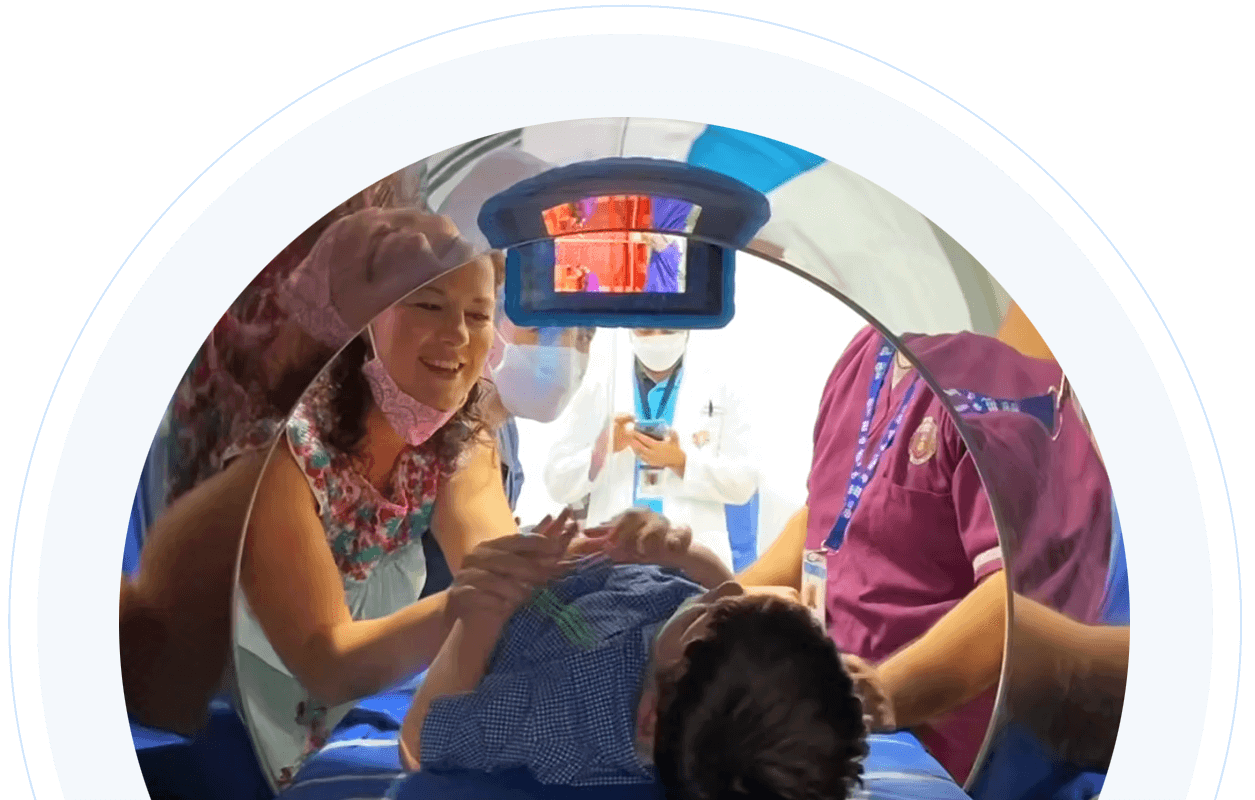
Once treatment begins, the functional neurogenesis device uses electromagnetic signal emitters, arranged in rings around the patient. The device generates a magnetic field, while simultaneously emitting radiofrequency waves, a low-energy form of electromagnetic radiation that can interact with neural stem cells in the brain.
Scientists have been exploring ways to use electromagnetic stimulation to power the body’s regenerative programs for many years, starting with technologies like pulsed electromagnetic fields (PEMF) for bone growth1,2 or deep brain stimulation (DBS) for neurologic conditions.3,4 Because electromagnetic fields are produced by the body and direct the organization of tissues during development and wound healing,5 researchers believe that electromagnetic stimulation could harness our cells’ natural responses to this kind of energy to promote neural regeneration.6
Emerging evidence from our imaging data suggests that functional neurogenesis stimulation may lead to an increase in gray and white matter volume, both essential components of brain structure, along with a rise in the number of neural tracts—pathways that connect different regions of the brain. Our technology may activate well-documented neuronal growth factors and cellular pathways to support the development of new neurons and the creation of new long-distance connections between neurons in the brain, potentially offering new ways to repair damage caused by incurable neurological disorders, such as cerebral palsy, autism and traumatic brain injury.
How are our protocols administered? #
Prior to administering the protocol, each medical case is reviewed by our team of neurologists to determine eligibility. An MRI scan is used to visualize the brain structure and precisely locate the area to focus the radiofrequency signals. The MRI data is then analyzed to customize the protocol based on the individual's neurological condition. Our technicians then calibrate the device to administer calculated doses of radiofrequency waves during a one-hour session, conducted at the same time each day, for 28 days.
How we study our technology’s impact #
Over 500 people with various neurological conditions have now received our protocols at our clinical research center in Monterrey, Mexico. Encouraged by results from our initial clinical trial with children suffering from cerebral palsy, we have expanded our trials to assess the impact of our protocols on autism spectrum disorders and have also developed research protocols for stroke, traumatic brain injury (TBI), vascular dementia, and the neurological impacts of COVID-19.
References #
- Cadossi R, Massari L, Racine-Avila J, Aaron RK. Pulsed Electromagnetic Field Stimulation of Bone Healing and Joint Preservation: Cellular Mechanisms of Skeletal Response. J Am Acad Orthop Surg Glob Res Rev. May 2020;4(5):e1900155. doi:10.5435/JAAOSGlobal-D-19-00155
- Varani K, Vincenzi F, Pasquini S, et al. Pulsed Electromagnetic Field Stimulation in Osteogenesis and Chondrogenesis: Signaling Pathways and Therapeutic Implications. Int J Mol Sci. Jan 15 2021;22(2) doi:10.3390/ijms22020809
- Bucur M, Papagno C. Deep Brain Stimulation in Parkinson Disease: A Meta-analysis of the Long-term Neuropsychological Outcomes. Neuropsychol Rev. Jun 2023;33(2):307–346. doi:10.1007/s11065-022-09540-9
- Cajigas I, Morrison MA, Luciano MS, Starr PA. Cerebellar deep brain stimulation for the treatment of movement disorders in cerebral palsy. J Neurosurg. Sep 1 2023;139(3):605–614. doi:10.3171/2023.1.JNS222289
- McCaig CD, Rajnicek AM. Electrical fields, nerve growth and nerve regeneration. Exp Physiol. Jul 1991;76(4):473–94. doi:10.1113/expphysiol.1991.sp003514
- McCaig CD, Rajnicek AM, Song B, Zhao M. Controlling cell behavior electrically: current views and future potential. Physiol Rev. Jul 2005;85(3):943–78. doi:10.1152/physrev.00020.2004